building sales from scratch
My lessons from rebuilding GTM at a founder-led B2B services firm transitioning from network sales to structured demand.
Some time ago I took on an engagement with a founder-led B2B services firm that had stalled at the edge of its own network.
Revenue came from two places: legacy clients and bids on freelance marketplaces that converted occasionally but unpredictably. The firm had no CRM. Few client promoters sporadically in the past. No outbound. No marketing function. No website worth ranking. No proposal materials that survived contact with an enterprise buyer. No salespeople. And no idea how to hire for any of those things.
This is the most common position I see in services firms that hit the "we need to scale" inflection. The founder's network has been the engine. Now the engine is the ceiling.
Let’s do some diagnostics
When I run an initial assessment for a firm in this position, I look at five things:
Strategy. Does the firm know what it sells/to whom/why those buyers should choose it over the alternative? In most cases the answer is holistic. Nothing is written down. Nothing is repeatable.
Function. Is there a sales function at all, or is the founder still doing every commercial conversation themselves? In this case: the founder was the function.
Materials. What can the buyer found out about the firm if he looks for it? In this case: a website nobody had touched for a long time, no thought-leadership content, and a presentation deck without sales elements or addressing buyer outcomes.
Network reach. how far does their network really extend? In this case: dried up legacy — all bounded.
Operational flow. Can the firm actually deliver if a new client appears tomorrow? In this case: yes, but with limitations. Operational scaling and commercial scaling are not the same problem, and most firms confuse them.
Across all five, the answer in this case was the same: built for survival, not for scale.
Growth as an Octopus
Most sales playbooks show a funnel, which is usually borrowed from product companies. Awareness, consideration, decision. Demand-gen at the top, conversion at the bottom, attribution tying it all together. That model is displaced for a B2B services firm at this stage and in the conditions we are living in today. Services buyers don't move through a single funnel. They move through a network of trust signals — research (often AI-driven now), referrals, partner introductions, vendor approvals, conference conversations, tender shortlists, ecosystem co-sells. The work isn't to pour traffic into the top of a tube. Your job is to build credibility across multiple compounding channels and let the channels reinforce each other.
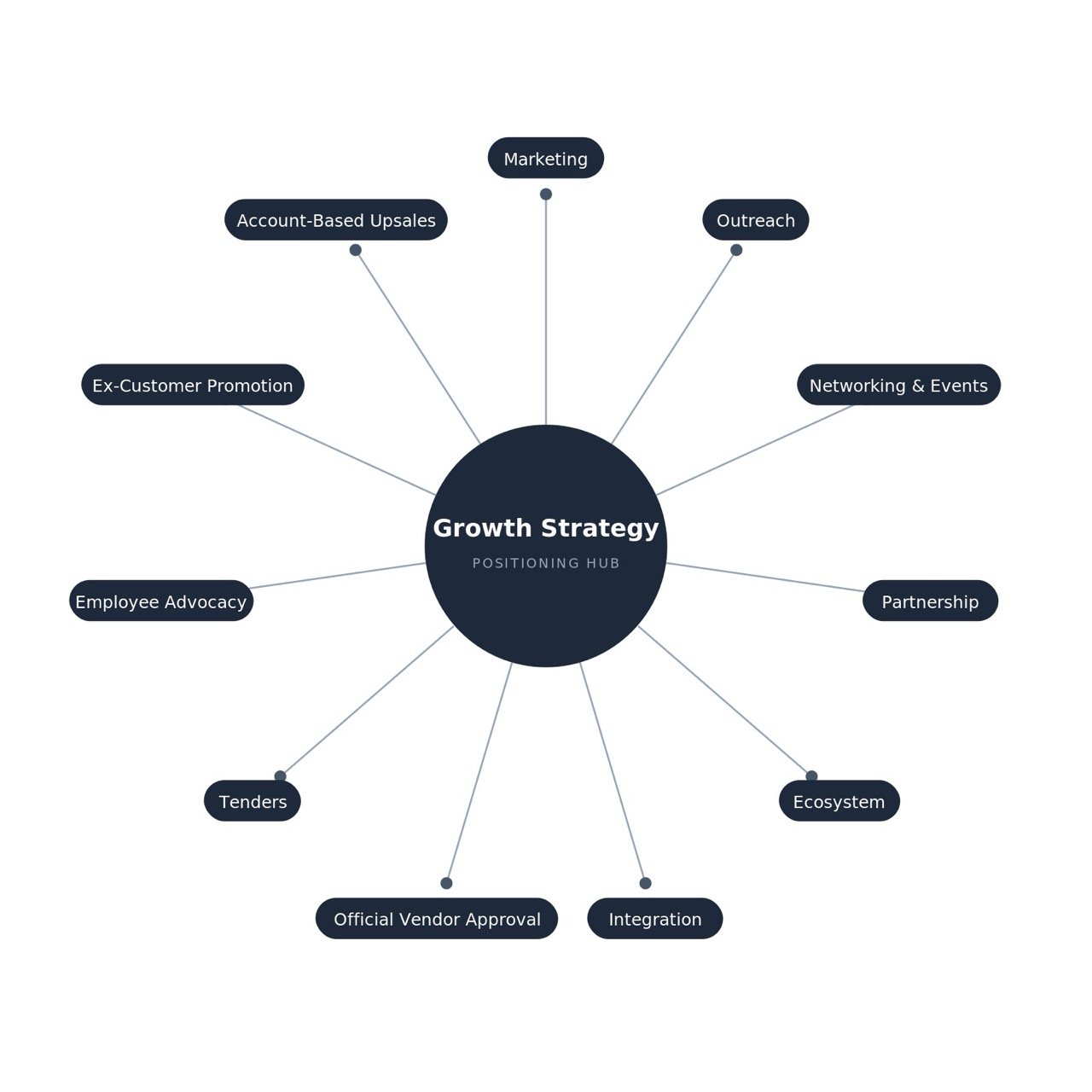
Growth Octopuc
The hub is positioning and value proposition — the why we exist and for whom answer. The branches are the channels where credibility gets built and pipeline gets sourced. The point of having a circle is that no single branch carries the business. They reinforce each other - your growth starts to have roots.
The eleven tentacles:
Marketing — owned content, website, AI-adoption, thought leadership, SEO.
Outreach — targeted automated outbound sequences to ICP buyers, calibrated to the value proposition tied back to signals that are aligned with marketing info.
Networking & events — physical presence in the rooms where buyers form opinions.
Partnership — strategic alliances with technology vendors whose buyers overlap with yours.
Ecosystem — broader presence in the platform and community where your buyers already operate.
Integration — joint propositions with technology stacks your clients are already running.
Tenders — RFP and procurement-led pipeline, where structured services buyers source.
Official vendor approval — registration on procurement panels and approved-supplier lists.
Employee advocacy — structured programme where employees amplify the firm's brand and source pipeline through their own networks (LinkedIn presence, conference participation, warm intros from peers in adjacent companies). The talent on the bench is also the distribution.
Ex-customer promotion — case studies, testimonials, references, and structured outreach to former clients for repeat work and warm intros. Most service firms still leave this implicit and miss the asset they already paid to build.
Account penetration — land-and-expand inside accounts that already buy. New stakeholders, new business units, new use cases. The highest-conversion pipeline available is the account you already deliver to; most firms underinvest here because they treat sold accounts as "delivered" rather than "platform."
What we built — and in what order
You cannot start ten tantacles at once. The sequencing is the work.
Phase one — the hub. I worked with the C-level on strategy: positioning, value proposition, and the messaging architecture. Until the firm knows what it sells and to whom, every other investment compounds the wrong narrative. This is the most boring and the most under-invested step in every founder-led services firm I have worked with.
Phase two — foundation spokes. Marketing materials, website, sales deck, proposal templates. I hired a Marketing Manager and worked alongside them on the website rebuild and the content scaffold. Without these, the credibility signal is missing when an inbound buyer look for the firm.
Phase three — sales function. I hired the first salespeople and onboarded them. I built the process: CRM hygiene, qualification framework, pipeline cadence, forecast discipline. The first sales hires in a services firm are decisive. Wrong hires push the founder back into the rainmaker seat for two more years.
Phase four — ecosystem and credibility. Partner approval programmes, integration co-sells, vendor registrations, tender targeting. These are slow-burn branches — months to years to mature. Started early, harvested late. The firms that delay this work are the ones still waiting on referral pipeline three years later.
Phase five — compounding assets. Three channels that draw on what the firm already owns and most firms leave implicit:
Employee Advocacy. The talent on the bench is also the distribution. Structured programme: LinkedIn presence, conference participation, warm intros from peers in adjacent companies. Real incentives, not posters in the kitchen.
Ex-Customer Promotion. Case studies, testimonials, references, structured outreach to former clients. Every sold engagement is an asset the firm paid to build — most firms walk away from it the moment the invoice clears.
Account penetration. The highest-conversion pipeline available is the account you already deliver to. New stakeholders, new business units, new use cases. Most firms treat sold accounts as "delivered" rather than "platform" — that's the easiest unforced error to correct.
Three lessons for founders facing the same transition
Your network is the ceiling, not the engine.
Hire the sales function before you think you're ready.
The framework matters less than the discipline. The Growth Strategy is a structural mental model. The work is the weekly cadence of executing across the tantacles. A firm that runs three directions well will outperform a firm that lists ten and operates none. Pick the three you can sustain, build them to maturity, then add the fourth. The temptation to "do everything" is the most expensive mistake at this stage.
What scaling sales actually means
Scaling sales is not buying tools. It is not running campaigns. It is not hiring a single AE and waiting.
It is building a function with a positioning hub, a portfolio of compounding channels, repeatable processes, and a leadership model that does not depend on the founder being in every commercial conversation. The Growth Strategy Octopus is a way to see the shape of that function before you build it.
If you are a founder reading this and your engine is still your network — you already know it. The question is whether you start the structural work before the network ceiling becomes a revenue plateau.
Solomiya Zahray is the founder of Zahray Consulting, an independent GTM and growth advisory practice based in Paris. She advises B2B technology and services firms on sales function buildout, partnership strategy, and commercial scaling.